Cabinets — stock vs semi-custom vs custom
Cabinets are often the biggest line item in a kitchen remodel. The right choice depends on your layout, storage needs, finish level, and budget — not just the showroom display.
Start with the simple truth: cabinets drive a big part of the budget
In many kitchens, cabinets take about 25% to 30% of the total remodel budget. That is why this choice matters so much. If your total kitchen remodel is a minor refresh, you may spend less by keeping the same layout and replacing doors, painting, or using stock boxes. If you are doing a mid-range or full-gut remodel, new cabinets can quickly become the main cost driver.
Typical cabinet price ranges for the cabinets themselves, before the rest of the kitchen is added, often look like this:
- Stock cabinets: about $100 to $300 per linear foot for basic lines, with installed totals often landing around $3,000 to $10,000+ depending on kitchen size and finish level
- Semi-custom cabinets: about $150 to $650 per linear foot, with many installed projects around $8,000 to $25,000+
- Custom cabinets: often $500 to $1,200+ per linear foot, with installed projects commonly $20,000 to $50,000+
These are typical ranges, not quotes or guarantees. Real price depends on the size of your kitchen, the scope of work, the materials, and your area. Labor, demolition, flooring changes, electrical updates, permits, and countertops are separate costs in most remodels. For a full budget picture, see kitchen remodel costs and our cabinet buying guide.
One more point people miss: paying more does not always mean better value. Sometimes semi-custom gives you the best mix of fit, looks, and cost.
What stock, semi-custom, and custom really mean
These terms sound clear, but stores and remodelers do not always use them the same way. Ask exactly what is included.
Stock cabinets
Stock cabinets are mass-produced in standard widths, heights, and depths. They usually come in a smaller set of colors, door styles, and accessories.
Good fit for:
- Straightforward layouts
- Tighter budgets
- Fast timelines
- Rental properties or basic updates
Tradeoffs:
- Fewer sizes, so fillers may be needed
- Less choice in wood species, finishes, and storage accessories
- Harder to fit older homes with uneven walls or unusual dimensions
Semi-custom cabinets
Semi-custom starts with standard cabinet boxes, then adds more options. You may get more sizes, finish choices, depth changes, trim details, and storage upgrades.
Good fit for:
- Most homeowner remodels
- Kitchens where you want better storage and a more built-in look
- Homes where a few non-standard sizes help reduce wasted space
Tradeoffs:
- Costs more than stock
- Lead times are usually longer
- Too many upgrades can push the price close to custom
Custom cabinets
Custom cabinets are built to your exact kitchen and design goals. This is where you can match odd spaces, special storage needs, old-home dimensions, or a very specific style.
Good fit for:
- High-end remodels
- Homes with unusual layouts
- Kitchens where every inch matters
- Matching historic details or special finishes
Tradeoffs:
- Highest cost
- Longer production time
- Quality depends heavily on the shop and installation crew
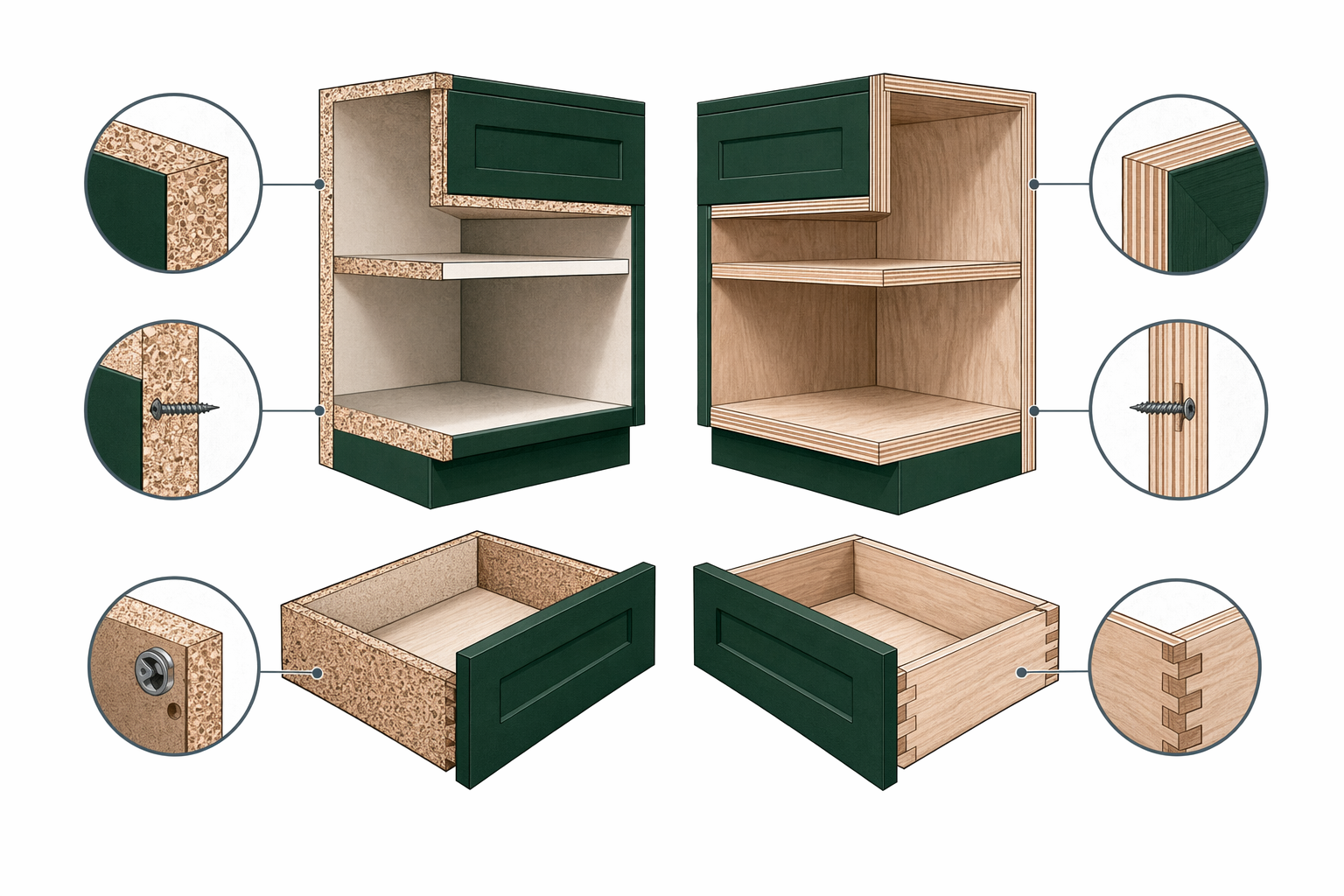
The big decision is not just cabinet type. It is also construction quality. Ask about plywood vs particleboard boxes, drawer box material, soft-close hardware, shelf thickness, interior finish, and warranty terms.
How to choose without wasting money
A smart cabinet decision usually comes from function first, then style.
1. Measure your pain points now
Think about what is wrong with your current kitchen.
- Not enough drawers?
- Pots hard to reach?
- Dead corner space?
- No pantry storage?
- Too little room near the stove or sink?
2. Decide if the layout is staying the same
If you keep plumbing, gas, and major appliance locations where they are, you may save a lot. That can make better cabinets possible within the same total budget.
3. Spend where you touch the kitchen every day
Good drawers, full-extension glides, and solid hinges matter more than fancy trim in many homes.
4. Choose door style and finish with resale in mind
Shaker and other simple styles are often easier to live with and easier to match later. Very trendy finishes can date the kitchen fast.
5. Watch the upgrade list
Glass doors, pull-out organizers, spice towers, tray dividers, panel-ready ends, furniture feet, under-cabinet lighting trim, and specialty inserts all add up.
A practical rule: if your kitchen is a normal shape and you want better fit than basic stock, semi-custom is often the sweet spot. If your layout is simple and the budget is tight, stock can work well. If your kitchen has difficult dimensions or you want a one-of-a-kind result, custom may be worth the extra cost.
If cabinets are part of a larger project, this overview of a full kitchen remodel can help you see how cabinet choices affect the whole job.
Common mistakes that cost homeowners later
People usually do not get burned because they picked the wrong door color. They get burned because they did not pin down the details.
- Comparing bids with different cabinet lines
One remodeler prices builder-grade particleboard boxes. Another prices plywood boxes with better hardware. The totals look different because the products are different.
- Focusing only on the cabinet price
Installation quality matters. A good cabinet installed badly will still look bad and wear badly.
- Not asking what fillers and panels are included
End panels, toe-kick finish, crown molding, refrigerator panels, and filler strips can change the number a lot.
- Ignoring lead time
A cheap cabinet line is not a bargain if delays leave your kitchen half-finished for weeks.
- Overbuilding for the house
A luxury custom package may not make sense in a modest home or if you plan to move soon.
- Skipping the written scope
You need the cabinet brand or shop, door style, finish, box material, hardware type, accessory list, installation details, timeline, and payment terms in writing before any deposit.
- Not checking who is responsible for damage and adjustments
Ask who handles delivery issues, missing parts, touch-ups, and final door and drawer alignment.
Always hire licensed and insured remodelers for the project and verify the license and insurance yourself. Get the price and scope in writing before any deposit. Follow local permits and building code. If you need help comparing companies, use this guide to vet a kitchen contractor.
What to ask before you sign
Bring this checklist to every cabinet conversation. It will save you money and confusion.
Ask these questions:
- What cabinet line or shop are you pricing?
- Are the boxes plywood, particleboard, or MDF?
- Are drawer bottoms and shelves thick enough for heavy use?
- Are hinges and glides soft-close and full-extension?
- What cabinet sizes are available, and how much filler will be used?
- What accessories are included, and what costs extra?
- Are finished end panels, crown, light rail, and toe-kick included?
- How long is the lead time?
- Who installs the cabinets?
- What warranty applies to the cabinets and the installation?
Then compare apples to apples:
- Same layout
- Same box material
- Same door style
- Same finish level
- Same hardware level
- Same accessory list
- Same installation scope
If you also need countertops, remember they are a separate major cost. Quartz countertops are often about $60 to $120 per square foot installed, but the real number depends on edge profile, thickness, color, cutouts, and your area. This countertop material guide can help you compare that part of the budget too.
Next step: narrow your options and compare local remodelers
You do not need to know every cabinet brand before you start. You just need a clear budget range, a rough style, and a list of must-have storage features.
A simple next step looks like this:
- Save 3 to 5 kitchen photos you like
- Write down your must-haves and your nice-to-haves
- Set a realistic total budget range
- Decide whether stock, semi-custom, or custom matches that budget
- Get matched with local licensed and insured kitchen remodelers
- Compare the written scope carefully before you choose who to hire
CopperSill is a free matching service. We help homeowners compare local kitchen remodelers. We do not remodel kitchens or provide construction advice. You compare quotes, you choose who to hire, and you hold the final payment. If you are ready, start here: get matched.
If your budget is tight, stock cabinets may work. If you want better fit and features, semi-custom is often the best middle choice. If your kitchen has unusual dimensions or you want a high-end result, custom may be worth it. Compare written scopes carefully, hire licensed and insured remodelers, verify that yourself, and do not pay a deposit until the price and details are in writing.