Quartz vs Granite Countertops — Which Is Right for You?
Both quartz and granite are popular for a reason. The better choice depends on how you cook, how much upkeep you want, the look you like, and your total kitchen budget.
The short answer
If you want low maintenance and a more consistent look, quartz is often the easier choice. If you want natural stone with one-of-a-kind pattern and better heat resistance, granite may be the better fit.
There is no single best countertop for every kitchen. The real price and best option depend on the size of your kitchen, the scope of work, the materials you choose, and your area.
A simple rule of thumb:
- Choose quartz if you want easy cleaning, no sealing, and colors that are more uniform.
- Choose granite if you like natural variation, want a slab that is truly unique, and do not mind some upkeep.
- If you are comparing a whole remodel budget, remember countertops are only one part of the total. Cabinets usually take a big share of the budget too. See typical remodel ranges at kitchen remodel costs or compare materials in our countertop material guide.
For many US homeowners, quartz and granite both land in the mid to upper part of a kitchen budget. Installed pricing often overlaps. The final number can change a lot based on edge profile, slab thickness, cutouts, sink type, backsplash, demolition, and local labor rates.
How quartz and granite are actually different
These materials can look similar in photos, but they are built differently.
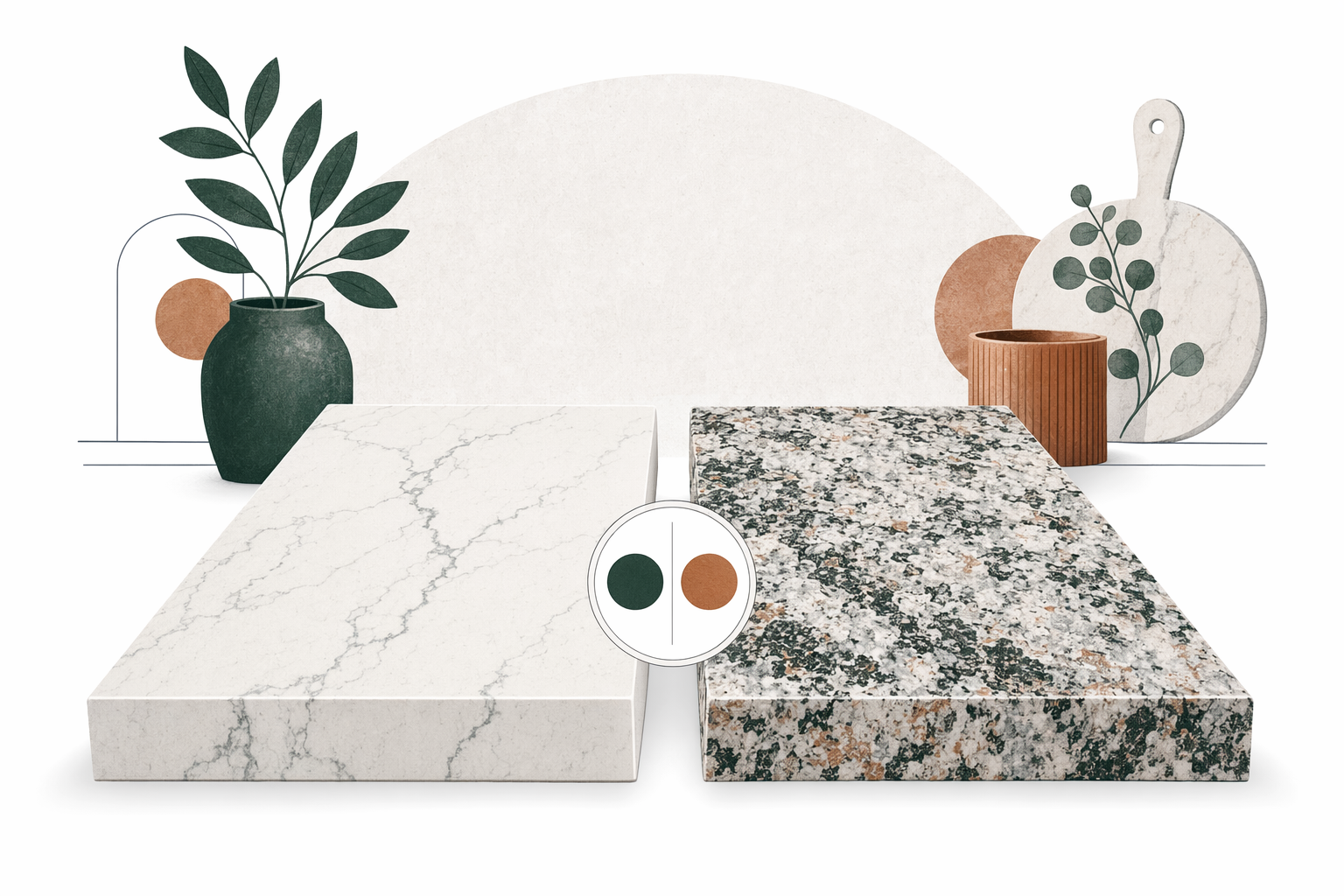
Quartz is an engineered surface. It is made from crushed stone mixed with resins and pigments. That gives it a controlled color and pattern. It is usually non-porous, which means it resists staining better and does not need sealing in normal use.
Granite is a natural stone cut from the earth. Every slab is different. You will see movement, color changes, and mineral marks that cannot be copied exactly. Granite is porous to different degrees, so many products need sealing from time to time.
What that means in real life:
- Appearance
- Quartz: cleaner, more even, easier to match from sample to final slab
- Granite: more natural movement, more variation, each slab is unique
- Maintenance
- Quartz: usually wipe and go
- Granite: simple to care for, but may need sealing and quicker cleanup on oils or wine
- Heat
- Quartz: decent for normal kitchen use, but hot pans can damage the resin
- Granite: generally handles heat better, though trivets are still smart
- Stain resistance
- Quartz: usually stronger here because it is non-porous
- Granite: can do well too, but depends on the stone and sealer
- Sunlight
- Quartz: not always ideal for strong direct sun, especially in outdoor or very bright areas
- Granite: usually a safer bet in sunny conditions
If your kitchen gets hard daily use from kids, heavy cooking, and quick cleanup, quartz wins a lot of people over because it asks less from you. If you care most about real stone and natural beauty, granite still has a strong case.
Cost, value, and where people get surprised
Homeowners often ask which one is cheaper. The honest answer: either one can be cheaper or more expensive depending on the exact slab and installation details.
A typical installed range for either quartz or granite is often about $60 to $120 per square foot installed, but premium colors, thicker slabs, waterfall edges, hard seam layouts, or tricky kitchens can push the price higher. That is an estimate, not a quote.
Common cost drivers:
1. Square footage of countertop and backsplash
2. Number of cutouts for sink, faucet, cooktop, soap dispenser, or outlets
3. Edge profile such as eased, bevel, ogee, or mitered edge
4. Slab thickness and whether plywood support is needed
5. Demolition and haul-away of old tops
6. Leveling or cabinet repairs before installation
7. Your local labor market and material availability
A few honest budget notes:
- A small kitchen may still cost more than expected if the layout is complex.
- The prettiest slab in the yard may be a premium tier.
- Seams matter. A low price is not a good deal if seam placement looks bad.
- Sink choices can change cost. An undermount sink install can be different from a drop-in setup.
- Countertops should be planned with cabinets, backsplash, and plumbing at the same time. If you are replacing tops during a larger project, start with the full countertops plan, not just a slab price.
For resale, both quartz and granite are widely accepted by buyers. Neither guarantees a return. The better value usually comes from choosing a material that fits the home, the neighborhood, and the rest of the kitchen instead of overspending on one feature.
Which one fits your kitchen and habits?
Here is the practical way to decide.
Quartz may be right for you if:
- You want the easiest day-to-day care
- You like white, soft gray, or clean modern looks
- You want a more predictable pattern across a large island
- You do not want to think about sealing
- You cook a lot but are good about using trivets for hot pans
Granite may be right for you if:
- You want real natural stone and do not want a manufactured look
- You like bold movement, depth, and variation
- You want stronger heat tolerance near cooking zones
- You do not mind periodic sealing if the stone needs it
- You are willing to visit the slab yard and pick the exact slab
Questions to ask yourself before you choose:
1. How much upkeep will I really do? Be honest.
2. Do I want a uniform look or a unique slab?
3. Will my cabinets and flooring compete with a busy stone pattern?
4. Do I have a big sunny window or patio-style kitchen exposure?
5. Am I choosing for my own use, or trying to appeal to future buyers too?
One more truth: the sample in a store can mislead you. A small chip does not show full movement, veining, or color shift. For granite especially, ask to see the full slab. For quartz, ask where the seams may land and whether the veining direction can be controlled.
If you are also shopping for cabinets, make sure the countertop choice works with the door style, backsplash, and wall color. Busy counters plus busy cabinets can make a small kitchen feel crowded. Our cabinet buying guide can help you avoid that mistake.
What to do next so you do not get burned
A countertop choice is not just about material. It is also about who measures, fabricates, and installs it.
Use this checklist:
- Get at least 2 to 3 written estimates that show material, thickness, edge, cutouts, backsplash, removal, and installation.
- Hire licensed and insured remodelers or countertop pros where required, and verify the license and insurance yourself.
- Ask who is responsible for final field measurements and what happens if cabinets are out of level.
- Ask to see the actual slab or exact product line before approving.
- Get the price and scope in writing before any deposit.
- Follow local permits and building code if the countertop work is part of a larger kitchen remodel involving plumbing, electrical, or layout changes.
- Hold final payment until the work is complete and you have checked seams, overhangs, polish, sink fit, and damage.
CopperSill is a free matching service. We do not install countertops or remodel kitchens. We help you plan the project and compare local pros. You compare quotes, you choose who to hire, and you hold the final payment. If you want help finding local licensed and insured remodelers for your project, start here: get matched or learn how to screen companies in our guide on vetting a kitchen contractor.
Pick quartz if you want easy care and a cleaner, more even look. Pick granite if you want real natural stone and better heat resistance. Get 2 to 3 written estimates, verify license and insurance yourself, and do not pay in full until the job is finished right.